The problem I wanted to solve
Most retail trading bots over-trust their own signals. A screener flags a candidate, the bot acts, and every false positive costs real money — because at no point did anything ask whether the signal deserved to be trusted in the first place.
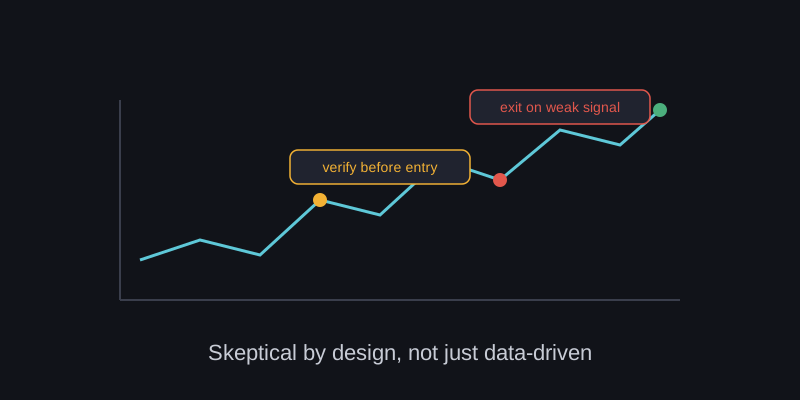
So the bot screens roughly 300 stocks and crypto assets against fundamental criteria, not just price action — but the screening isn't the point. Plenty of tools do that. The point is the multi-stage verification layer sitting on top of it: an AI pass that cross-checks the underlying data for accuracy and pulls in relevant news context before a position is treated as valid, not after the fact.
What it actually produces
-
query_statsFundamentals-based screening~300 stocks and crypto assets screened against fundamental criteria, not just price action.
-
fact_checkAn AI verification passData accuracy cross-checked and news context pulled in before any signal is treated as valid.
-
shieldExits that don't waitPositions are actively closed the moment there's a reasonable signal something is turning.
Biased toward exiting, not just entering
A trade that looks fundamentally sound today can stop being sound fast — a news event, a data anomaly, a shift in the underlying thesis nobody flagged yet. The bot is built to actively close positions the moment there's a reasonable signal something is turning, rather than holding through weakness on the hope the original thesis still applies.
The actual design goal wasn't finding good trades — it was making sure the system is never late to recognize a bad one.
How it feels to use
-
Screen~300 stocks and crypto assets checked against fundamental criteria.
-
VerifyAn AI pass challenges each candidate — is the data accurate, and does the news context still support it?
-
Watch the exitsAnything that stops looking sound gets closed — no holding on hope.
Why this one is different
Beyond the obvious appeal of a system that might eventually manage its own risk well, this turned out to be a genuinely useful exercise in a broader, more transferable skill: getting an AI model to verify data rather than just generate it. Using AI as a second-opinion layer — one that checks the first layer's assumptions instead of just producing more of them — is a more interesting problem than using AI purely as a signal generator, and it's a pattern worth reusing well beyond trading.
Its simpler sibling, the Binance threshold monitor, handles the always-on watching; this system is the deep verification layer. Today it runs against my real positions in paper-trading mode inside QuantLab, with live updates from those sessions feeding back into the optimization.
Not live money, and not close to it yet. The bar for that transition is simple and non-negotiable — it has to prove itself against real data over real time before any actual capital goes near it. Fundamentals-based systems are easy to convince yourself work in hindsight, and much harder to prove will keep working going forward; that gap is exactly what the ongoing optimization exists to close. Nothing in this post is financial advice.