The problem I wanted to solve
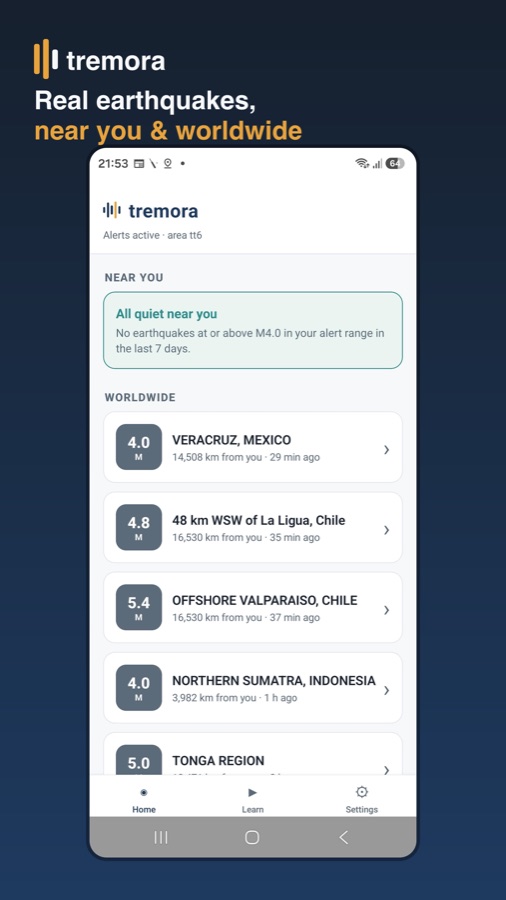
Standard earthquake feeds report events by region or country. But shaking doesn't respect borders, and "an earthquake happened nearby" isn't actionable on its own. A magnitude 6 quake 150km away might rattle windows and knock things off shelves. The same quake 800km away means nothing at all.
Existing apps mostly leave that translation to the reader. Tremora does the math for them — including across borders, so a quake in a neighboring country still reaches the people who'd actually feel it.
What it actually produces
-
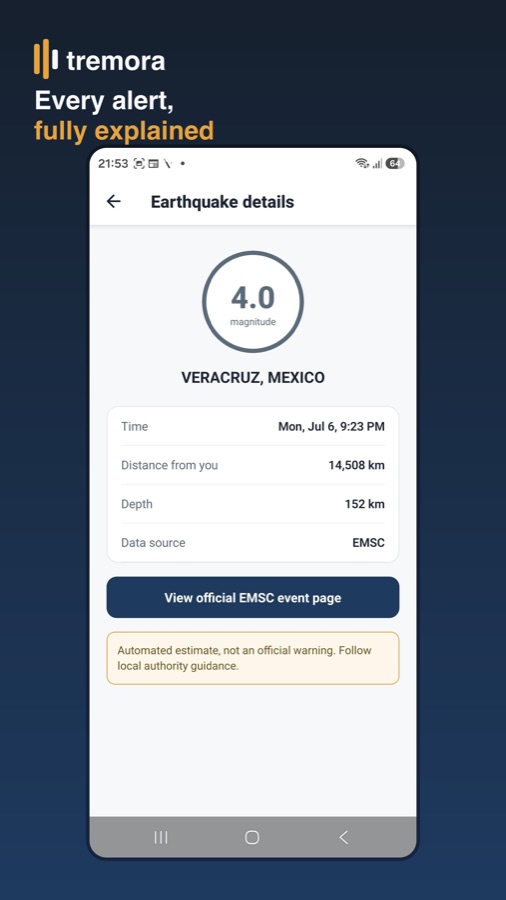
notifications_activeAlerts about what you'll feelDistance from the epicenter is bucketed into three tiers — likely felt strongly, may feel mild shaking, or a major nearby event unlikely to be felt at all.
-
publicAlerts that cross bordersA quake in a neighboring country still reaches the people close enough to feel it — no region-locked feeds.
-
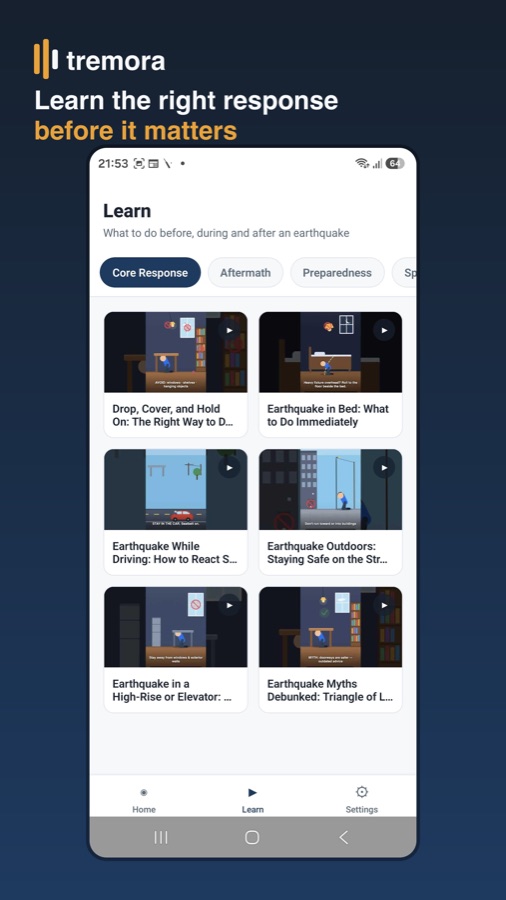
health_and_safetyGuidance for the moment it happensA knowledge library covering what to do during, and after, real shaking — for the situation you're actually in.
How it actually works
Tremora polls live seismic feeds (USGS and EMSC) every one to two minutes. When a new event crosses a magnitude threshold, it checks the distance from every registered user to the epicenter and buckets the likely effect into the three tiers above. Only genuine matches trigger a push notification, so the app stays useful rather than noisy.
The poll-evaluate-alert skeleton behind all of this started life as a solar monitoring workflow — the architecture traveled here almost unchanged: poll a feed, evaluate a condition, alert only the people it affects.
Under the hood, the backend doesn't loop through individual users on every poll — that doesn't scale and risks missing people during a busy event. Instead, users are grouped into geographic cells, and a new earthquake triggers a push to only the affected cells as a batch. Each device then runs a lightweight local calculation to personalize the exact distance and label shown. Firebase handles storage and delivery — and at current scale, effectively for free.
The part we're most proud of: knowing what to do
An alert is only as useful as what someone does with it. Tremora's knowledge library covers the fundamentals — drop, cover, hold on, done properly — situational guidance for where you actually are when shaking starts (driving, in bed, in a high-rise, outdoors), the aftermath (why so many injuries happen from re-entering buildings too soon after the main event), and circumstances general guidance often skips, like mobility considerations or being with young children.
This is the one place in the entire app where we can make an unqualified accuracy claim, because it's sourced from established disaster-response guidance rather than anything we invented.
How it feels to use
-
Set your locationRegister once — the app takes it from there.
-
Get only the alerts that matterWhen a quake crosses the threshold near you, a push arrives with a plain-language estimate of what you'll feel — nothing else does.
-
Know what to doOpen the guidance library for your exact situation — during the shaking, and in the risky hours after it.
Why this one is different
This is the part we spent the most time thinking about, not building. Reliable short-term earthquake prediction — the "when and where before it happens" kind — isn't a solved problem for anyone, at any budget, including national seismological agencies with far more resources than a two-person build. An app that implied otherwise wouldn't just be dishonest, it would be actively dangerous: a false sense of security is worse than no information at all.
Every alert Tremora sends carries an explicit disclaimer — automated estimate, not an official warning, official sources always take priority.
What's next: an experimental, clearly-labeled phase exploring phone-accelerometer-based early warning — the same underlying principle behind Google's Android Earthquake Alerts and UC Berkeley's MyShake, where phones detect a quake's fast, mostly harmless first wave and warn people further out before the damaging wave arrives. That's real, already-deployed technology, not a prediction claim — and the natural next step once Tremora has enough active users for a crowdsourced network to actually mean something.